MessagesMessage Archive

September 2026 – Present

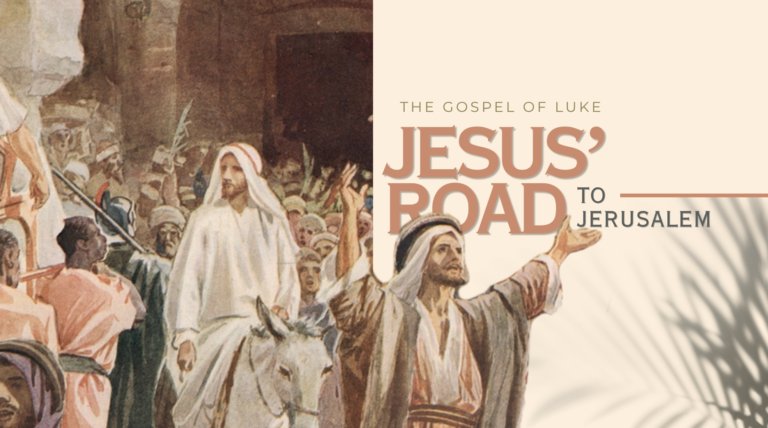
Jesus' Journey to Jerusalem

Luke 15 to Luke 24

7 messages

Luke gives Jesus’ journey to Jerusalem ten chapters, while Mark covers the road in roughly two. Luke’s extended “travel narrative” is where he gets his own voice: about a third of it is found nowhere else.

Only Luke gives us the Prodigal Son, the lost coin, the dishonest manager, Lazarus and the rich man, the persistent widow, the Pharisee and the tax collector, and Zacchaeus. His unique miracles include the healing of the ten lepers.

His distinctive emphases are:

  • God’s grace seeking the lost
  • warnings about wealth and possessions
  • reversal of status, with outcasts and Samaritans as models
  • humble prayer
  • the kingdom present yet still coming
  • faithful stewardship until the King returns

Above all, Luke makes discipleship a ‘road’: following Jesus toward the cross, with the “Son of Man” seeking and saving the lost along the way.

In order

Sunday, September 13, 2026

God is Committed to Finding the Lost

Ian Brinksman

Luke 15:1-32

Message 01

Summary

Jesus saw things differently from the religious leaders of his day. They practiced keeping their distance from tax collectors & sinners. They saw that as a way to be right before God. Jesus, on the other hand, had no issue having meals & conversations with the very same people. What’s the difference? Jesus mirrored God’s heart & mission. He came to seek & to save the lost (Lk. 19:10). Because of these differences, the religious leaders openly grumbled & complained when Jesus ate & spoke with ‘outcasts.’ How does he help us to see that our hearts & lives are sometimes out of kilter with God’s heart? He tells 3 parables in Luke 15 around the theme of lost, found & rejoicing. And while his audience was the religious leaders, there is much for us all to learn from these simple stories that ask us to check where our heart is at when it comes to the lost people in our lives.

Sunday, September 20, 2026

Who Will Welcome You?

Del Martin

Luke 16:1-13

Message 02

Summary

This parable may be one of the most troubling and difficult parables to appreciate. Readers are often puzzled by the actions of the unrighteous manager and, especially, by the fact that he is commended. However, it is not his dishonesty that is praised, but rather the wisdom and shrewdness behind his actions. The manager recognized that his present position was coming to an end, and he acted decisively to prepare for his future.

The central lesson of the parable is that we are to use our wealth and possessions wisely to benefit others. When we use what God has entrusted to us for the good of others and for the advancement of His kingdom, we are investing in eternity. The way we use our money reveals what we value and has eternal significance.

This parable, together with the one that follows, speaks directly about money and how we handle it. It serves both as a warning and an encouragement: a warning not to allow wealth to control us, and an encouragement to use the resources God has entrusted to us wisely, generously, and for the benefit of others and the kingdom of God.

Sunday, September 27, 2026

Economics of the Afterlife (Luke 16)

Nigel Tomes (PhD Econ.)

Luke 16:14-17, 19-31

Message 03

Summary

Every investor asks the same question: how can today's resources secure tomorrow? Last week's parable told us to invest our present wealth in 'making friends' who'll welcome us in the age-to-come. This week, Jesus shows us a portfolio gone entirely wrong. A rich man spends lavishly on himself — purple linen, daily feasts — while Lazarus, destitute, lies unattended at his gate. At death, accounts are settled: Lazarus is carried to Abraham's side; the rich man finds himself impoverished in torment, separated by a fixed, uncrossable chasm. His failure wasn't extravagance itself — it was a total misallocation. He had the means, the opportunity, and the instruction (the Law and the Prophets) to invest in Lazarus. He committed nothing and got zero return. Death is the ‘market correction’ that exposes every account's true value. So, examine your own portfolio: who is the ‘Lazarus at your gate’? What return are you expecting from relational investments --‘making friends who’ll welcome you in the next age’-- by using your time, attention, and wealth today?

Sunday, October 11, 2026

It Starts As An Ordinary Day…

Ian Brinksman

Luke 17:20-37

Message 05

Summary

When Jesus returns will we be ready, or more importantly, ask yourself, ‘will I be ready?’ One thing that won’t help us be ready is if we merely focus on ‘when’ he will return or what ‘signs’ might precede his return. What he warns his followers of is for them to be watchful & faithful, & to live in this manner in the mundane, ordinary days of life. Prior to Jesus’ return everyone will be eating, drinking, marrying, going to work & school, & planting & building. What are we to be aware of as we do these things? That if we aren’t careful, they can tether us to earth in such a way that we are not ready for his return. So, don’t focus on knowing when Jesus will return, but focus on living today in relationship with him so when he returns you will embrace him & leave all temporary things behind.

Sunday, October 18, 2026

The Trouble with Prayer

Del Martin

Message 06

Summary

Most of us would hesitate to say that we are great at prayer. In this passage, Jesus addresses three aspects of prayer through two parables. In the first, a persistent widow repeatedly appeals to a judge for justice. Through her example, Jesus calls us to pray continually and never give up, assuring us that God will bring justice to His suffering, chosen people.

The second parable contrasts two people and their approaches to prayer. One is self-righteous and looks down on others, while the other comes before God as a repentant sinner. This parable challenges us because, if we are honest, we may see something of ourselves in both individuals. May these two parables prompt us to examine our own prayers, deepen our dependence on God, and inspire meaningful change in our lives.

Sunday, October 25, 2026

Who Was Jesus' Last Disciple?

Nigel Tomes

Luke 18:18-30; 18:35-19:3 (with Mark 10:46-52 alongside)

Message 07

Summary

It sounds like Bible trivia, but it isn’t. While walking this earth, who was the last person to step onto the road to follow Jesus?

Jesus is nearing the end of his journey to Jerusalem. For the first and only time, he will pass through Jericho. It is the final chance for a life-changing encounter, the chance to become his last disciple. Luke 18-19 offers three candidates: the rich young ruler, the blind beggar Mark names as Bartimaeus, and Zacchaeus, the short, wealthy tax collector.

Ironically, the one Jesus called to follow him declined, while the one who followed was never called at all. He was a volunteer, not a conscript, yet he became Jesus’ last disciple. Their encounters have much to teach us today.

Sunday, November 1, 2026

The Tax Cartel’s Kingpin, a son of Abraham?

Ian Brinksman

Luke 19:1-10

Message 08

Summary

As Jesus neared the end of his journey to Jerusalem, he passed through the prosperous city of Jericho. There, Zacchaeus --a wealthy chief tax-collector who had grown rich by exploiting his neighbors --was determined to see Jesus. Despised by the crowds, he could not get close enough, so he ran ahead and climbed a tree to catch a glimpse of him. Little did he know that Jesus came looking for him! Jesus stopped, called Zacchaeus down, and invited himself into his home. That encounter changed everything. Zacchaeus publicly declared his repentance, promising to give generously to the poor and repay fourfold anyone he had defrauded. Jesus declared that salvation had come to his household. Jesus warned about the difficulty the rich faced to enter God's kingdom; yet, Zacchaeus proves that no one is beyond the reach of God's grace. When Christ saves people, lives are transformed.

These messages are free to use — please credit Church in Toronto. About this archive

All series

Updated November 6, 2026.