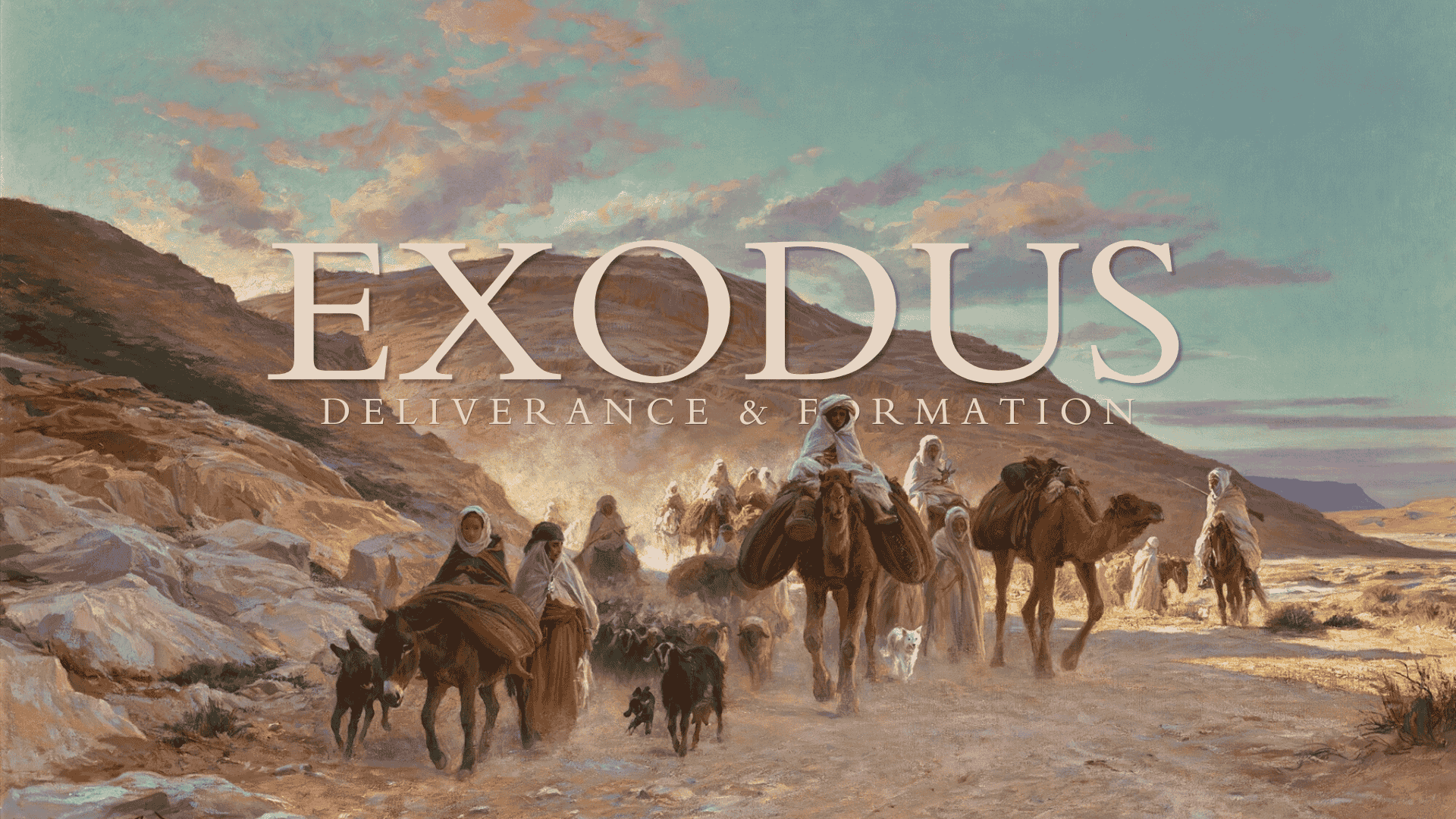
The Church in the Wilderness: Under God's Wrath?
Sunday August 9, 2026 · Nigel Tomes
#6: Exodus 17:1-7; Psalm 95:6-11; Hebrews 3:7-14
Bible Reading: Exodus 17:1-7
1 The whole community of the Israelites traveled on their journey from the wilderness of Sin according to the LORD's instruction, and they pitched camp in Rephidim. Now there was no water for the people to drink. 2 So the people contended with Moses, and they said, "Give us water to drink!" Moses said to them, "Why do you contend with me? Why do you test the LORD?" 3 But the people were very thirsty there for water, and they murmured against Moses and said, "Why in the world did you bring us up from Egypt—to kill us and our children and our cattle with thirst?" 4 Then Moses cried out to the LORD, "What will I do with this people? — a little more and they will stone me!" 5 The LORD said to Moses, "Go over before the people; take with you some of the elders of Israel and take in your hand your staff with which you struck the Nile and go. 6 I will be standing before you there on the rock in Horeb, and you will strike the rock, and water will come out of it so that the people may drink." And Moses did so in plain view of the elders of Israel. 7 He called the name of the place 'Massah' ['Test,' 'Trial'] and 'Meribah,' ['Strife,' 'Revolt'] because of the contending of the Israelites and because of their testing the LORD, saying, "Is the LORD among us or not?" (Exodus 17:1-7 NET)
Summary:
Israel provides a pattern for the Church. In Exodus, God delivered Israel from slavery through mighty acts—including the Red Sea crossing—and led them through the wilderness toward Mt. Sinai. Israel's failures and God's faithfulness provide a template for Christians' journey today. It warns us; despite witnessing God's miracles, the exodus generation repeatedly rebelled, climaxing at Meribah and Massah. Psalm 95 records the harsh verdict: for 40 years their unbelief angered God; He swore they would never enter His rest.
Hebrews 3–4 applies this psalm to us, casting believers as a new "wilderness generation" journeying under Christ toward our promised rest. Written about 40 years after Pentecost—a season marked not by wrath but by miracles and the Spirit's power—Hebrews reminds us we are under grace, not judgment. With Christ as our greater Moses and High Priest, let us hold fast in faith and enter God's rest.
- Israel & the Church in the Wilderness –the Parallel
- The Parallel
- “If you had asked a devout Israelite in the OT period, ‘Are you redeemed?’ the answer would have been a most definite ‘Yes.’ …If you had asked, ‘How do you know?’…[he/she] would have recounted…the story of the exodus.” --Christopher Wright
- “Hebrews wants its readers to think of themselves as in some ways like that [exodus] generation, walking through the wilderness on the way to God’s promised future; & they mustn’t make the mistakes that the Israelites did.” --NT. Wright
- On a Journey: Out of Egypt, via the Wilderness, to the Mountain, onward to Promised Land
- Where are you? Still in Egypt? Going to the Red Sea? Across the Red Sea, Camping? Journeying onwards?
- Where are you? Camping beside the Red Sea? Camping in the wilderness? “Speak to the people to go forward”
- The Warning We're Tempted to Misapply
- "Israel's passage through the sea is analogous to Christian baptism …As Christ lived out the wilderness experience, so does the church…Hence, the warning of Psalm 95 not to 'harden your hearts' as Israel did in the wilderness is applied to the church as it stands between its 'Egypt and Canaan'." — Peter Enns
- A Familiar Failure –Meribah & Massah (Ex. 17:1-7)
- After God’s Mighty Saving Acts (Deut. 4:32-37)
- Later Moses asks Israel: “Has anything like this great event ever happened, or has anything like it been heard of? 33 Has a people heard God’s voice speaking…as you have, & lived? 34 Or has a god attempted to go & take a nation as his own out of another nation [i.e., Egypt], by trials, signs, wonders, & war, by a strong hand & an outstretched arm, by great terrors, as the LORD your God did for you in Egypt before your eyes? 35 You were shown these things so that you would know that the LORD is God; there is no other besides him…37 Because he loved your ancestors, he chose their descendants after them & brought you out of Egypt by his presence & great power…” (Deut. 4:32-37 CSB)
- A Familiar Failure (Ex. 17:1-7)
- "The Israelites forgot God‘s miracle of parting the Red Sea… God turned the bitter water sweet. [But,] this did not change their hearts, & when they encountered hunger in the wilderness of Sin, they still complained against Moses…Complaining & murmuring was a sin that the Israelites kept committing while in the wilderness… Unfortunately, the Israelites failed the test in Exodus 17." — Caroline Mwangi
- Massah -Meribah: Exodus 17:3-7; Numbers 20
- Massah/Meribah is the climax of a pattern, not an isolated lapse — it was repeated –Exodus 17 & Numbers 20 --
- “The Lord heard your words, He grew angry & swore an oath: ‘None of these men in this evil generation will see the good land I swore to give your ancestors, except Caleb…” (Deut. 1:34-36)
- God’s Harsh Verdict (Ps. 95)
- God “says, “Don’t be stubborn like they were at Meribah, like they were that day at Massah in the wilderness, 9 where your ancestors challenged my authority, & tried my patience, even though they had seen my work. 10 For 40-years I was continually disgusted with that generation, & I said, ‘These people…do not obey my commands.’ 11 So I made a vow in my anger, ‘They will never enter into the rest…” (Psalm. 95:8-11 NET)
- "They suffered God's wrath for the remaining 40-years of their lives & their corpses fell unattended in the desert, but they lost the blessing for which God had redeemed them from Egypt…The 'rest' they forfeited was far more than real estate [land] in Canaan and thus worthy of our utmost pursuit." — Gareth Cockerill
- “Rest” in Ps. 95:11 –Not just the promised land (@David’s time “Don’t be like…” they’re already in the land)
It names both the temporal consequence & the eternal one, which is exactly the weight this section needs.
- NT Application -- The Crucial Turn – “Therefore” (Heb. 3:10)
- The New Testament Application of the Old Testament Verdict (Heb. 3:10; Ps. 95:10)
- In Ps. 95:9-10 God says: “your ancestors tried me, though they had seen what I did. 10 For 40-years I was angry with that generation…” (Ps. 95:9-10 NIV)
- Heb. 3:9-10 quotes Ps. 95: “where your ancestors tested & tried me, though for 40-years they saw what I did. 10 That is why I was angry with that generation; I said, ‘Their hearts are always going astray, & they haven’t known my ways.’ (NIV)
- Hebrews quotes Ps. 95 as: "…your fathers tested me…and they saw My works 10 for 40 years. 'Therefore, I became provoked [to anger] at that generation'" (Heb. 3:9-10 CSB)
- Textual evidence –in Psalm 95:10 there’s no “therefore” either in the Hebrew or the Greek OT LXX
- The Implications of “Therefore” (Heb. 3:10)
- "The addition of 'therefore' [in Heb. 3:10] changes the meaning significantly…[Hebrews] reads the 40-year period not as the period of God's wrath, but as the period of God's activity in the desert…" — Peter Enns
- The Church: Not Under God’s Wrath, but His Blessing --Peter Enns
- “Ps. 95 views the wilderness period negatively. But…the church's period of wilderness wandering is not one of wrath but of blessing... In Heb. 2:4 they saw 'signs & wonders, various miracles, &…gifts from the Holy Spirit' …They saw…the inauguration of the church age…not a show of God's anger… Hebrews is telling…[the church] their wilderness period is one of blessing, not wrath or punishment." --Peter Enns
- “Hebrews…extracts a blessing from Psalm 95.” --Bryan Estelle
- “Hebrews takes a Psalm [95] which dealt with a curse & punishment but now extracts a blessing from it by demonstrating…there’s a final rest…those who are faithful can enter…[if] they…maintain their Christian faith.” --Bryan Estelle
- “The negative tone of…Psalm [95] …is turned inside out” -- George Guthrie
- “The negative tone of the Psalm [95] …is turned inside out…there is a rest to be entered for those who take the opposite path [to Israel, i.e.,]…of belief and obedience." — George Guthrie
- This is the hinge itself — it's the textual evidence lets the congregation see the move rather than take your word for it.
- The Call: “Today, if you hear His voice…”
- Warning & Encouragement
- “He again specifies a certain day—'today.’ …speaking through David after such a long a time Today, if you hear his voice, do not harden your hearts.’ (Heb. 4:7)
- "Watch out, brothers & sisters, so that there won't be in any of you an evil, unbelieving heart that turns away from the living God. But encourage each other daily, while it is still called 'today,' so that none of you is hardened by sin's deception." — Hebrews 3:12-13
- The Rest That Remains (Heb. 4:1-2)
- “Therefore, since the promise to enter his rest remains, let us beware that none of you be found to have fallen short. 2 For we also have received the good news just as they did…” (Heb. 4:1-2)
- "The promise for the obedient people of God, who believe Him, hearing His 'voice' is that they enter His 'rest'. The negative tone of the Psalm…is turned inside out…there is a rest to be entered for those who take the opposite path [to Israel, i.e.,]…of belief and obedience." — George Guthrie
- Applications
- There’s “a parallel between our Christian walk & the Israelites’ journey from Egypt. The Israelites were slaves there. We were slaves too… When we were ‘born-again’ we were set free & were no longer slaves… The Israelites saw the Red Sea part for them, & then watched the Egyptian [forces] drown in the Sea…Next the Israelites traveled through the Wilderness. Where were they going? To the Promised Land [via the Mountain--Sinai]. God is bringing us through the Wilderness, as well. Yet, some [people] will stay in Egypt. Others will stay in the Wilderness too long… The Israelites got stuck in the Wilderness. But why? Will you get stuck there, or is there something more ahead? --Jason Anderson
Bible Reading: Exodus 17:1-7
1 The whole community of the Israelites traveled on their journey from the wilderness of Sin according to the LORD's instruction, and they pitched camp in Rephidim. Now there was no water for the people to drink. 2 So the people contended with Moses, and they said, "Give us water to drink!" Moses said to them, "Why do you contend with me? Why do you test the LORD?" 3 But the people were very thirsty there for water, and they murmured against Moses and said, "Why in the world did you bring us up from Egypt—to kill us and our children and our cattle with thirst?" 4 Then Moses cried out to the LORD, "What will I do with this people? — a little more and they will stone me!" 5 The LORD said to Moses, "Go over before the people; take with you some of the elders of Israel and take in your hand your staff with which you struck the Nile and go. 6 I will be standing before you there on the rock in Horeb, and you will strike the rock, and water will come out of it so that the people may drink." And Moses did so in plain view of the elders of Israel. 7 He called the name of the place 'Massah' ['Test,' 'Trial'] and 'Meribah,' ['Strife,' 'Revolt'] because of the contending of the Israelites and because of their testing the LORD, saying, "Is the LORD among us or not?" (Exodus 17:1-7 NET)
Summary:
Israel provides a pattern for the Church. In Exodus, God delivered Israel from slavery through mighty acts—including the Red Sea crossing—and led them through the wilderness toward Mt. Sinai. Israel's failures and God's faithfulness provide a template for Christians' journey today. It warns us; despite witnessing God's miracles, the exodus generation repeatedly rebelled, climaxing at Meribah and Massah. Psalm 95 records the harsh verdict: for 40 years their unbelief angered God; He swore they would never enter His rest.
Hebrews 3–4 applies this psalm to us, casting believers as a new "wilderness generation" journeying under Christ toward our promised rest. Written about 40 years after Pentecost—a season marked not by wrath but by miracles and the Spirit's power—Hebrews reminds us we are under grace, not judgment. With Christ as our greater Moses and High Priest, let us hold fast in faith and endeavor to enter God's rest.
- The Wilderness Wanderings of the Original Exodus Generation (~1440 or 1260 BC)
- The Exodus Generation’s repeated unbelief on the way to the Mountain
- "When the Israelites had left Egypt and were in the wilderness, they feared life in the desert (Ex. 14:12). This is evidenced by their faithlessness when they could not find water in the wilderness...Due to the sinful nature of the human heart, the Israelites forgot God's miracle of parting the Red Sea, and they complained against Moses (Ex. 15:22–25). This showed a lack of trust in God. To test their faith, God turned the bitter water sweet." [Caroline W. Mwangi, "Wilderness Motif in the Bible: Biblical Theology Approach," ShahidiHub International J. of Theology & Religious Studies, Vol. 5 #1 (2025)]
- "However, this [miracle] did not change their hearts, & when they encountered hunger in the wilderness of Sin, they still complained against Moses (Ex. 16). Complaining and murmuring was a sin that the Israelites kept committing while in the wilderness. God used the wilderness to test them & gauge the faithfulness of the Israelites towards Him[self]. Again, the testing was also for God to ascertain His relationship with the Israelites so that He might bless their faithfulness. Unfortunately, the Israelites failed the test in Exodus 17. While camping at Rephidim, they complained & grumbled against Moses because there was no water to drink. They put God to the test after encountering God's miracles & divine provision. This distressed Moses, and he called the place Massah & Meribah (Ex. 17:7), for the Israelites quarreled against God and Moses at that place." [CW. Mwangi, Op. cit. p]
- Despite Experiencing God’s Saving Works (Deut. 4:32-37)
- Later Moses asks Israel: “Has anything like this great event ever happened, or has anything like it been heard of? 33 Has a people heard God’s voice speaking…as you have, & lived? 34 Or has a god attempted to go & take a nation as his own out of another nation [i.e., Egypt], by trials, signs, wonders, & war, by a strong hand & an outstretched arm, by great terrors, as the LORD your God did for you in Egypt before your eyes? 35 You were shown these things so that you would know that the LORD is God; there is no other besides him…37 Because he loved your ancestors, he chose their descendants after them & brought you out of Egypt by his presence & great power…” (Deut. 4:32-27 CSB)
- “God tested his people in the wilderness with miraculous signs & provisions in order to know which hearts were faithful (Dt. 4:34…) …[In] Israel’s wilderness experience [they] were continually confronted with miraculous signs yet failed to believe. Signs ultimately revealed the hard hearts of those who lacked faith.” [Daniel H. Fletcher, Signs in the Wilderness, p. xiv]
- Massah/Meribah ‘bookend’ the whole wilderness period
- "Meribah & Massah…indicate the whole spectrum of Israel's rebellion in the wilderness…[because] the two incidents at this place essentially bracket the wilderness wandering: the first [Ex. 17] almost at the beginning, and the second [Num. 20] almost at the end of the wandering (Ex. 17:1-7 and Num 20:8-13)." [Richardson A. Oyediran, "'Rest' in…Hebrews," p. 6]
- “The rebellion at Meribah/Massah forms a frame around virtually the entire wilderness rebellion period… Meribah and Massah may be a shorthand not just for Exodus 17 or Numbers 20 but [for] both --and everything in between.” [Peter Enns, “Creation & Recreation,” p. 266]
- Israel Refuse to enter the Land, & are Condemned to 40-years Wilderness Wandering
- God told Israel:34 “You will bear the consequences of your iniquities 40-years…You will know my displeasure. 35 I, the Lord, have spoken. I swear that I’ll do this to the entire evil community that…conspired against Me. They’ll come to an end in the wilderness, & there they’ll die.” 36 So the men Moses sent to scout out the land, & who… incited the entire community…by spreading a negative report about the land— 37 those men…were struck down by the Lord. 38 Only Joshua…& Caleb…remained alive of those…who…scout[ed] out the land.” (Num. 14:34-38)
- Moses reminded the Exodus generation that at the Promised Land’s border, “You rebelled against the command of the LORD your God. 27 You grumbled in your tents & said, ‘The LORD brought us out of…Egypt to…destroy us, because He hates us…When the LORD heard your words, He grew angry and swore an oath: 35 ‘None of…this evil generation will see the good land I swore to give your ancestors, 36 except Caleb…” (Deut. 1:26-27, 34-36]
- "Frequently, the wilderness period served as the consummate example of Israel's rebellion & disobedience, but also of God's miraculous provision. The wilderness became symbolic of the time of preparation in the [twilight zone] between deliverance and inheritance." [Jesse B. Coyne, World of the Wilderness in…Hebrews, New Orleans Baptist Theol. Sem., (2015) p. xvii]
- Psalm 95:7-11 — The Retrospective Verdict: Israel under God's Wrath (~1000 BC)
- “Come, let’s worship and bow down; let’s kneel before the Lord our Maker. 7 For he is our God…Today, if you hear his voice: 8 Do not harden your hearts as at Meribah, as…at Massah in the wilderness 9 where your ancestors tested me; they tried me, though they had seen what I did. 10 For 40-years I was disgusted with that generation; I said, “They are a people whose hearts go astray; they do not know my ways.” 11 So I swore in my anger, ‘They will not enter my rest’.” (Psalm 95:6-11 CSB)
- Note: Psalm 95 is described as God speaking “through [king] David, after so long a time [after the exodus]” (Heb. 4:7)
- One key phrase here is ‘they tried me, even though they had seen my deeds’ [v. 9b] …The Psalm ends…with God declaring separation from the very people God delivered [from Egypt] in the first place… The entire psalm has stressed the power of the Lord that saved the Israelites…& the anger of the Lord over the actions of the people.” [Beth Tanner, Psalms, p. 717]
- How the Psalm itself frames the 40 years
- "For 40 years I was continually disgusted* with that generation, & I said, 'These people desire to go astray; they do not obey my commands. They will never enter into the resting place I had set aside for them.’” (Ps. 95:10-11 NET) *"an imperfect…emphasizes the ongoing nature of the condition in the past." [NET note]
- "In Ps. 95:10 'God was angry for 40 years’…God's anger was a characteristic of the wilderness period." --Peter Enns
- The Wilderness Generation under God's Wrath – “I swore in My wrath” (Ps. 95:11 ESV)
- "The disobedience of the wilderness generation [at Meribah & Massah] …may be understood as a challenge to God's honor, specifically God's sufficiency as patron & benefactor. God's response, given in Ps. 95:10-11 as wrath is an expression of God's understanding of being slighted, rather than simply being fed up with the Israelites." [David de Silva, "Despising Shame," JBL, Vol. 113/3 (1994) pp. 452-3]
- "The prominent negative example in Hebrews is…the wilderness generation (Heb. 3:7-4:11), which, because of its failure to appreciate God's sufficiency as patron, provoked God to anger, thereby losing the benefits God promised them--a thing highly to be feared (Heb 4:1). The author of Hebrews approaches the example of the wilderness generation through Psalm 95…In the Hebrew Psalm 95:8-9 refers to the events at Meribah & Massah related in Exodus 17:1-7 & Numbers 20:2-13." [David de Silva, Op. cit., p. 452]
- Severe Loss: forfeiting the promise, not just the land
- “Deut. 1:34-35…recounts the divine oath…that the exodus generation would not enter the land: ‘the LORD… became angry & made this vow: 35 “Not a single person of this evil generation will see the good land…I promised to give to your ancestors!’.” [Scott R. Moore, Conviction of Texts Not Seen, Univ. of Denver, CO. (2017) p. 167]
- "Because of [the exodus generation's] rebellion God 'swore that they would not enter into his rest'. What they suffered as a result of this rebellion under the divine oath was terrible, but not as bad as what they lost. They suffered God's wrath for the remaining 40-years of their lives & their corpses fell unattended in the desert, but they lost the blessing for which God had redeemed them from Egypt [the promised land & God's eternal rest] …The 'rest' they forfeited was far more than real estate [land] in Canaan & thus worthy of our utmost pursuit." [Gareth L. Cockerill, Yesterday, Today, & Forever, pp. 12-3]
- “What the exodus generation truly lost when they refused to enter…[They] didn’t just miss out on obtaining the land of Canaan…They missed out on…the fullness of God’s promised rest.” [David Moffitt, Exodus in Hebrews, p. 20]
- Later rabbis debated the exodus generation's eternal fate
- "In later Rabbinic writings, the question is addressed of whether the wilderness generation would have any portion in the world to come –evidently a popular…issue for rabbis in the post-NT era. Psalm 95 was used by some rabbis to teach that… the wilderness generation had no portion in the world to come. [Others disagreed.]" [George H. Guthrie, "Hebrews," in GK. Beale & DA. Carson (eds.), Commentary on the NT Use of…OT, p. 954]
- Later Biblical witness confirms the verdict
- "The Bible recounts…how [the wilderness] became a place of disobedience and punishment in (Ps 78:18, 40, 56; 95:8; 1 Cor 10:9; Heb 3:7–11,15; 4:7) so that all those who believe in Yahweh learn from the Israelites that they do not test the Lord and walk in rebellion." [Caroline W. Mwangi, Op. cit., p. ]
- Hebrews interrogates the Psalm 95 text
- “For who heard & rebelled? Wasn't it all who came out of Egypt under Moses? 17 With whom was God angry for 40-years? Wasn't it with those who sinned, whose bodies fell in the wilderness? 18 …To whom did he swear that they would not enter his rest, if not to those who disobeyed? 19 So we see that they were unable to enter because of unbelief.” (Heb. 3:16-19)
- The Negative Portrait of the Exodus Generation
- “The Exodus generation [is depicted in] Hebrews 3-4. This picture is entirely negative and characterized by apostasy. This is the generation who left Egypt, hardened their hearts, put Yahweh to the test, went astray, did not know God’s ways, were evil, disobedient, & fell away (Heb. 3:7-12). This exemplary act of sin is connected to Psalm 95 [which] addresses a later generation & exhorts them ‘not to harden their hearts today, as the rebellious generation in the wilderness hardened theirs’ …That Exodus generation is the epitome of rebellion and an [example to] be avoided for all generations of God’s people.” [David H. Wenkel, “Contrasting Portraits of…Exodus Generation in Hebrews,” Scottish Bull. Evangel. Theol. (2015) p. 151]
- One caveat: Richard Phillips notes, “Despite their many failures & rebellions, that generation did perform one great act of faith: the exodus itself & the passage through the Red Sea [Heb. 11:29].” [Richard Phillips, Hebrews, p. 506]
- “By faith they crossed the Red Sea…on dry ground…When the Egyptians tried it, they were swallowed up.” (Heb. 11:29)
______________________________________________________________________________________
- Hebrews (~70 AD) Uses & Modifies Psalm 95 -- The Church versus Israel
Hebrews 3:12-14
- “12 Watch out, brothers & sisters, so that there won't be in any of you an evil, unbelieving heart that turns away from the living God. 13 But encourage each other daily, while it is still called 'today,' so that none of you is hardened by sin's deception. 14 For we have become participants in Christ if we hold firmly until the end the reality that we had at the start” (Hb. 3:12-4)
- The "Church in the Wilderness" Motif
- Note: “Church (Gk. ekklesia) in the Wilderness” appears in Acts 7:38 in relation to Moses & Israel in Sinai. “For Greek-speaking first-century Jews [ekklesia]…always…mean[t] Israel as the people of God.” –David Peterson
- “If you had asked a devout Israelite in the OT period, ‘Are you redeemed?’ the answer would have been a most definite ‘Yes.’ And if you had asked, ‘How do you know?’…[he/she] would have recounted the long & exciting story – the story of the exodus.” [Christopher J. H. Wright, Mission of God, p. 265]
- ‘Like Israel, we are saved from something (from slavery…) for something (to witness & to worship). This idea of being delivered ‘out of Egypt’ gets recorded many times in the Bible (Ex. 3:10, 17…)
- “Like Israel, we are saved by the blood of the lamb (Ex. 12…)”
- “Like Israel, we have been saved, & we are now sojourners & a holy priesthood, seeking to glorify God in word & deed until we reach the promised land.” [Tony Merida, Exalting Jesus in Exodus, p. ]
- “‘Hebrews wants its readers to think of themselves as in some ways like that [exodus] generation, walking through the wilderness on the way to God’s promised future; & they mustn’t make the mistakes that the Israelites did.” [NT. Wright, Hebrews for Everyone, p. 28]
- "Heb. 3 uses Ps. 95:7-11, placing its audience in an analogous situation to the Israelites in the wilderness." [ESV]
- "Israel's passage through the sea is analogous to Christian baptism (1 Cor. 10:1-2) …As Christ lived out the wilderness experience, so does the church. This is the point made in the use of Ps. 95 in Hebrews 3…Hence, the warning of Ps. 95 not to 'harden your hearts' as Israel did in the wilderness is applied to the church as it stands between its 'Egypt and Canaan'." [Peter Enns, "Exodus Route & Wilderness Itinerary," in T.D. Alexander (ed.), Dictionary of the OT: Pentateuch, p. 280]
- "The journey from bondage to the promised inheritance would be long and dangerous, but God would…protect and care for them. That period…would become an example in both the OT & NT. Redemption, whether…by means of the Passover or the Cross, involves a long and hard journey before the believer attains God's full promises." [Robert B. Hughes, Tyndale Concise Bible Commentry, pp. 36-37]
- The ‘Already and Not Yet’ Parallels for the Christian & the Israelite
- “The NT writings…present or presuppose the…Christian life as a journey or new exodus-wilderness pilgrimage in which [end-time] salvation overlaps the two ages of present & future. The Christ-followers may be interpreted as [having an intermediate existence –‘saved-but-not-yet-fully-saved’] in which faithfulness and perseverance are necessary if their salvation is to be fully realized at the culmination of time when Christ returns. …Until the promised ‘rest’ is fully realized, the Christ-followers’ plight remains somewhat similar to Israel’s wilderness generation. They wander & face diverse tests while advancing through the metaphoric [wilderness]… They must persevere in faith and not succumb to sin which… [produces] apostasy.” [B.J. Oropeza, “Warning Passages in Hebrews,” Currents in Biblical Research (2011) p. 7]
- Jesus our ‘New Moses’ leads us through ‘the Wilderness’
- "In the NT [Jesus] is the 'new Moses'…In Heb. 3:1-6…Moses & Christ are compared as deliverers…Jesus is a new & better 'Moses'…It is through Christ (the new Moses) that we as the church (the new Israel) gain entrance into [the new heaven & new earth] (the new Promised Land)…Jesus as the new Moses has come…to deliver His people from a country more oppressive than Egypt (the present world order characterized by sin, death & eternal separation from God) and governed by a ruler far worse than Pharaoh (Satan)." [Peter Enns, Exodus, pp. 286-7]
- Heb. 3 "present[s] Jesus as the second Moses… [&] the church as the new wilderness community. As Moses led his people out of Egypt and through the desert, Jesus now leads his people through their wilderness… Jesus was sent by the Father to lead his people out of sin and guide them faithfully through their…wilderness wandering to a heavenly inheritance." [Peter Enns, "Creation & Re-creation: Ps. 95 & its Interpretation in Hebrews 3:7-4:13," Westminster Theological J., pp. 271-2]
- As "the original Exodus community which rebelled at Meribah and Massah was a community wandering through the wilderness, so too is the church a community of wilderness wanderers living between Egypt & Canaan with the ever-present possibility of rebellion…Israel and the church are in analogous situations. What once applied to Israel now finds its full meaning with respect to the church." [Peter Enns, "Creation & Re-creation," p. 272]
- Hebrews' Key Modification: The Insertion of "Therefore" (Heb. 3:10)
- Ps. 95 says “your ancestors tried me, though they had seen what I did. 10 For 40-years I was angry with that generation…” (Ps. 95:9-10 NIV)
- Hebrews quotes Ps. 95 as: "…your fathers tested me…, and they saw my works for 40 years. 'Therefore, I became provoked [to anger] at that generation'" (Heb. 3:9-10 CSB)
- "The point is that [Psalm 95:10] state[s] that God was angry for 40 years. In other words, God's anger was a characteristic of [Israel's] wilderness period. The addition of 'therefore' [in Heb. 3:10] changes the meaning significantly. The writer [of Hebrews] reads the 40-year period [not as] the period of God's wrath, but as the period of God's activity in the desert… God's anger [with Israel] is what follows the 40-year period in which they saw God's works." [Peter Enns, Op. cit., p. 273]
- From ‘40-years of God’s Wrath’ to ‘40-years of seeing God’s Works’
- "Both the Greek & Hebrew [OT] versions of this Psalm [Ps. 95] omit the 'therefore' from [Heb. 3:]10 & join the 'for 40-years' with what follows: 'For 40 years I was angry with this generation' [Ps. 95:10]. The addition of 'therefore' [in Heb. 3:10] does two things. [1.] First, it joins the 'for 40 years' with what has gone before: 'Your fathers tested me with proving & saw my works for 40-years'. Instead of the 40-years of wandering…being described as the time of God's anger, it is now described as a time of continued disobedience [& seeing God's works]. There was no repentance after the rebellion at Kadesh Barnea. [2.] Second, the 'therefore' makes it clear that the rebellion of the people was the cause of God's anger and resulting judgment." [Gareth L. Cockerill, Yesterday, Today, & Forever, p. 11]
- "In Heb. 3:10, the insertion of 'therefore' before 'I was angry,' forces…'40-years' in 3:10 to be read with 'they saw my works' in 3:9. This shift also stresses the wilderness generation's testing and observation of God's works." [Dana M. Harris, "Use of the OT in…Hebrews," SW Journal of Theology, Vol. 64, #1 (2021) pp. 93-94]
- Did God ‘Exclude’ & ‘Disown’ the Exodus Generation?
- The early Christian writing, the Epistle of Barnabas [~100 AD] makes the "provocative claim that Israel lost its covenant at Sinai… [This claim] finds a rhetorical analogue in the way that Deut. 5:2-3 'disowns' the generation that perished in the wilderness: 'The LORD our God made a covenant with us at Horeb [i.e., Sinai]. 3 Not with our fathers did the Lord make this covenant, but with us, who are all of us here alive today.' (Deut. 5:2-3 ESV). Within the NT [there's] no better analogy…than Hebrews 3:7-4:13." [James N. Rhodes, Op. cit., p. 181]
- "Hebrews emphasizes that the wilderness generation failed to enter God's promised rest because of their own sin & disobedience.…[It is] a sobering reminder that persistent hard-heartedness ultimately leads to exclusion from God's saving promises." [James N. Rhodes, Epistle of Barnabas & the Deuteronomic Tradition, p. 181]
- Exodus: Israel don’t Believe Moses’ Signs; John’s Gospel: People don’t Believe Jesus’ Signs
- “The term ‘sign’ occurs in…both…Exodus & John [which both] culminate in unbelief or ‘hardening of heart’ (Ex. 14:8; Jn. 12:37-40), as well as belief…Both Moses & Christ performed miraculous signs in the midst of the people. Both were met with a mixture of unbelief and belief.” [Daniel H. Fletcher, Signs in the Wilderness, pp. 5, 10]
- In “John’s Gospel… the rejection of Christ by the Jews [is] analogous to that of Moses in the wilderness by the first, heard-hearted generation…The grumbling of the people against Moses…[has] a strong parallel in John’s Gospel where the people grumble against Christ…Jesus receives the same response from many people during his ministry… ‘John’s use of the OT [‘grumbling’] motif…demonstrate[s] that the Jews of Jesus’ generation were committing the same offense against God that the wilderness generation had committed’ (Gordon).” [Daniel H. Fletcher, Op. cit., pp. 11-12]
______________________________________________________________________________________
- The Contrast Made Explicit: Israel's Wrath vs. the Church's Blessing
- 40-Years: Psalm 95 –Negative Vs. Hebrews --Positive
- Hebrews "wants to portray the wilderness period in a positive light—one that was not characterized by wrath… because his…quoting Psalm 95 is to warn the church, the new wilderness community… [In the OT] the entire 40-year period of wandering is the punishment for Israel's wanting to return to Egypt in Numbers 14. Ps. 95 views the wilderness period negatively. But this negative impression will not do for Hebrews. The church's period of wilderness wandering is not one of wrath but of blessing... They are not subject to God's punishment as was [Israel]…In Heb. 2:4 they saw 'signs & wonders, various miracles, & distributions of gifts from the Holy Spirit'…They saw the coming of Messiah & the inauguration of the church age…not a show of God's anger… Hebrews is telling his readers [the church] that their wilderness period is one of blessing, not wrath or punishment." [Peter E. Enns, "Creation & Re-creation," p. 274]
- New Testament believers witnessed God’s Works (Heb. 2:4)
- “In Heb. 2:4 [the church experienced] 'signs and wonders, various miracles, and…gifts from the Holy Spirit” --Peter Enns
- God’s great “salvation had its beginning when it was spoken of by the Lord, & it was confirmed to us by those who heard him. 4 At the same time, God also testified by signs and wonders, various miracles, and distributions of gifts from the Holy Spirit according to his will.” (Heb. 2:3-4)
- Note: Apparently the audience…of Hebrews were not eyewitnesses of Jesus, but [they] received the testimony from others [Heb. 2:3b]. God also bore witness…through miracles performed alongside the gospel’s proclamation, confirming it. The three terms ‘signs, wonders, & miracles’ overlap in meaning and thus should not be finely distinguished.” [ESV]
- “The church's 'wilderness period' is…not of punishment but of blessing” –Peter Enns
- "Peter Enns suggests that [Hebrews'] author wants to separate the wilderness period…conceived of as positive, from the time of judgment that followed… [Since, this] provides a more accurate parallel to the…church…The church's 'wilderness period' is a season not of punishment but of blessing, which parallels another strand of tradition…. Yet…Hebrews [also] recognizes the wilderness period as a time of God's anger [for the OT exodus generation] (Heb. 3:17) …In Heb. 3:10 [the author] has the church…upmost in mind, whereas the [OT] wilderness generation is squarely in view in Heb. 3:17." [George H. Guthrie, "Hebrews," p. 954]
- The Church is Not at the end of 40-years Wilderness Wandering
- “Hebrews does not envision [NT believers] at the end of…Israel’s 40-years of wandering…[It] locates them at a point prior to a Kadesh-Barnea-like event. They are…at the first opportunity to receive the inheritance…They are in a [Mount] Sinai-like position…at the end of Exodus.” [David Moffitt, Exodus in Hebrews, pp. 22-23]
- To Recap…
- "In the [OT Ps. 95:10] God's anger characterizes the 40-year period of [Israel's] wilderness wandering. In Hebrew's addition of 'therefore', the 40-years are now…associated with testing God & seeing His works. [Peter] Enns suggests [Hebrew's] author wants to separate the wilderness period, which he conceives as positive, from the time of judgment that followed…[since] this provides a more exact parallel to the [NT] situation of the church …The church's 'wilderness period' is a season not of punishment, but rather blessing…Yet…Hebrews [also] recognizes [Israel's] wilderness period as a time of God's anger (Heb. 3:17)…[3:10 is] Hebrew's author giving the Psalm [95] an entirely different meaning because in [Heb.] 3:10 he has the church…in mind." [George H. Guthrie, "Hebrews," p. 954]
- The positive promise still stands for the obedient
- "The promise for the obedient people of God, who believe Him, hearing His 'voice' is that they enter His 'rest'. The negative tone of the Psalm [95]…is turned inside out. [The fact] that the wilderness generation was not allowed to enter God's rest means…there is a rest to be entered for those who take the opposite path…of belief and obedience." [George H. Guthrie, "Hebrews," p. 956]
______________________________________________________________________________________
- Hebrews' Expanded View: "God's Rest" Means More Than the Promised Land
- ‘My rest’ in Psalm 95 – more than the promised land
- Although “God promised Moses that…He would give [His people] rest (Ex. 33:14), in Ps. 95 this is not general rest but God’s rest specifically (Heb. 4:9-10) …Despite…Joshua…Israel did not obtain God’s promised rest.” [Matthew Thiessen, “Hebrews & the End of the Exodus,” Novum Testamentum, V. 49 (2007) pp. 359-60]
- "In the wilderness context, the 'rest' is specifically the place of rest, i.e., the [promised] land; finally secured with David's reign (2 Sam. 7); but since the…congregation [singing Ps. 95] is already in the [promised] land, it follows that the psalm [95] is using 'rest' as an image of enjoying God's presence forever (…as Heb. 4:1, 11 does)." [Note on Ps. 95, ESV, p. 1059]
- Hebrews traces "rest" back to creation itself
- "Hebrews 3:7-4:13…affirm[s] that the ultimate goal of the people of God has always been the same. The 'rest' that they [the wilderness generation] forfeited, & that we their descendants must gain, was never simply the Promised Land that was entered under Joshua, but has always been the 'Sabbath rest' into which God entered at the culmination of creation. The 'My rest' of Psalm 95[:11] is the rest forfeited by the wilderness generation through rebellion (Heb 4:6; cf. 4:3; 3:11, 18), the rest offered in the time of David [Ps. 95] (Heb 4:7-8), & the 'rest' that 'remains' for those addressed by Hebrews (Heb 4:9-11) & thus for the people of God 'today.' The Promised-Land imagery and the use of 'rest' in contemporary sources indicate that this [‘My rest’] is not merely a blessed state but also a place where God's people dwell in his presence [forever]." [Gareth L. Cockerill, "From Deut. to Hebrews: Promised Land," Southern Baptist J. of Theology, Vol. 24.1 (2020) p. 86]
- Hebrews extracts a Blessing from a Psalm of Curse & Punishment
- “By interjecting a…reference to Gen. 2:2…Hebrews takes a Psalm [95] which dealt with a curse & punishment but now extracts a blessing from it by demonstrating that there’s a final rest…those who are faithful can enter…The conclusion…in Heb. 4:14…for this community [is] whether they will maintain their Christian faith.” [Bryan Estelle, “Exodus Motif in the Christian Bible,” BN. Wolfe (ed.) St Andrews Encyclopaedia of Theology (2023) p. ]
- Aspects of ‘Rest’ in Hebrews 3-4
- “The writer of Hebrews…look[s] at several facets of rest. [1.] First, there is the 7th-day rest of God when He ceased from his creative work (Heb. 4:4, 10). [2.] There is a 2nd aspect of rest, the rest which involved Israel's taking the promised land (Heb. 3:11, 18-19). The conquest of the land was viewed as a form of rest…in…Deut. 3:20; 12:9; 25: 19; Josh 11 :23 [etc.]. [3.] The 3rd facet of rest in Hebrews 3 and 4 is the promised rest. Here is the difficulty. What is being promised? …A number…take the promised rest to be eternal bliss, & several factors support this position. [a.] First, the promise of entering the rest (4: 1) implies that the blessing is a future one (cf. 4:11). [b.] 2nd, the heavenly estate described in Rev 14:13 refers to rest…A [further] interpretation takes this rest of Heb. 3:7-4:13 to anticipate the coming millennial kingdom age.” [Stanley D. Toussaint, “Eschatology of Warning Passages in…Hebrews,” Grace Theological Journal, Vol. 3.1 (1982) pp. 71-72]
- ‘Rest" as the heavenly Jerusalem, not Canaan real estate
- "God's rest…in Hebrews 4 [is] the place that God entered at creation (Gen. 2:2; Heb. 4:4). It is this that… readers strive to ensure they are not excluded from. This is the [end-time] goal of the people of God…The ultimate goal of the people of God is God's rest. God's rest is not in the promised land, Jerusalem, or the temple. Rather, it is in the world to come, the city to come, the heavenly Jerusalem, & the heavenly temple where God dwells and where Jesus is enthroned...The promised land…was only an interim goal on the way to the heavenly Jerusalem…[Hebrews] 'effectively denies that the historical entrance into the promised land [with Joshua] gave the people rest at all' (Walker)." [Philip Church, "Here We Have No Lasting City (Heb. 13:14)," in Peter Walker (ed.), Gospel & the Land of Promise, p.]
- The promise remained open after Joshua — and still remains open
- "Psalm 95 shows that Israel's wilderness generation rejected God's offer of rest in the promised land…Moreover, since God was still offering it after Joshua's day, the promise had never yet been completely fulfilled (Heb. 4:8); the full promise remained available for a new generation –the time of the promised future restoration of God's people." [John H. Walton & Craig S. Keener (eds.), NIV Cultural Backgrounds Study Bible, p. 2143]
- Hebrews' theological rationale for reading "rest" this way
- "For Hebrews' author, the fact that God…set a 'day' for entering the 'rest' (i.e., 'today') gives assurance that this 'rest' was not limited to the entrance into Canaan (Heb. 4:6-9) …Rather…in light of Genesis 2:2…God's rest is a spiritual reality… [that] we must strive to enter…" [George H. Guthrie, "Hebrews," p. 955]
Applications
- There’s “a parallel between our Christian walk & the Israelites’ journey from Egypt. The Israelites were slaves there. We were slaves too… When we were ‘born-again’ we were set free & were no longer slaves… The Israelites saw the Red Sea part for them, & then watched the Egyptian [forces] drown in the Sea…Next the Israelites traveled through the Wilderness. Where were they going? To the Promised Land [via the Mountain--Sinai]. God is bringing us through the Wilderness, as well. Yet, some [people] will stay in Egypt. Others will stay in the Wilderness too long… The Israelites got stuck in the Wilderness. But why? Will you get stuck there, or is there something more ahead? [Jason Anderson, Journey: Captivity, Wilderness, Promised Land, Where are you now? Where will You Go? pp. ]
- "Whatever circumstances we [Christian believers] find ourselves in…[it's] not that we are awaiting God's deliverance [from 'Egypt'], but that deliverance has already come, in Christ. We are not to say, 'What I'm going through is like Israel's Egypt experience,' but [we should say:] 'My Egypt is behind me. I'm on the other side of the Sea, so how am I expected to behave?'" [Peter E. Enns, Exodus, pp. 290-1]
- In "Israel's liberation from Egypt…God was claiming his right over Israel, to take his people out from under Pharaoh's rule & put them under His own rule. Exodus is not the story of Israel's release from Egypt, as if they can now go their merry way & build a Marxist-like utopia. Rather, they've left one form of slavery in order that they may be free to enter another form of slavery, to Yahweh. It's a journey…not merely…out of Egypt, but to Mount Sinai & the Law." [Peter E. Enns, Exodus, p. 292]
- …
Bible Reading: Exodus 17:1-7; Psalm 95:6-11; Hebrews 3:7-14
1 The whole community of the Israelites traveled on their journey from the wilderness of Sin according to the LORD's instruction, and they pitched camp in Rephidim. Now there was no water for the people to drink. 2 So the people contended with Moses, and they said, "Give us water to drink!" Moses said to them, "Why do you contend with me? Why do you test the LORD?" 3 But the people were very thirsty there for water, and they murmured against Moses and said, "Why in the world did you bring us up from Egypt—to kill us and our children and our cattle with thirst?" 4 Then Moses cried out to the LORD, "What will I do with this people? — a little more and they will stone me!" 5 The LORD said to Moses, "Go over before the people; take with you some of the elders of Israel and take in your hand your staff with which you struck the Nile and go. 6 I will be standing before you there on the rock in Horeb, and you will strike the rock, and water will come out of it so that the people may drink." And Moses did so in plain view of the elders of Israel. 7 He called the name of the place 'Massah' ['Test,' 'Trial'] and 'Meribah,' ['Strife,' 'Revolt'] because of the contending of the Israelites and because of their testing the LORD, saying, "Is the LORD among us or not?" (Exodus 17:1-7 NET)
Psalm 95:6-11
“Come, let’s worship and bow down; let’s kneel before the Lord our Maker. 7 For he is our God…Today, if you hear his voice: 8 Do not harden your hearts as at Meribah, as…at Massah in the wilderness 9 where your ancestors tested me; they tried me, though they had seen what I did. 10 For 40-years I was disgusted with that generation; I said, “They are a people whose hearts go astray; they do not know my ways.” 11 So I swore in my anger, ‘They will not enter my rest’.” (Psalm 95:6-11 CSB)
Hebrews 3:7-14
7 Therefore, as the Holy Spirit says: ‘Today, if you hear his voice, 8 do not harden your hearts as in the rebellion, on the day of testing in the wilderness, 9 where your ancestors tested me, tried me, and saw my works 10 for forty years. Therefore, I was provoked to anger with that generation and said, “They always go astray in their hearts, and they have not known my ways.” 11 So I swore in my anger, “They will not enter my rest.” 12 Watch out, brothers and sisters, so that there won’t be in any of you an evil, unbelieving heart that turns away from the living God. 13 But encourage each other daily, while it is still called ‘today’, so that none of you is hardened by sin’s deception. 14 For we have become participants in Christ if we hold firmly until the end the reality [or ‘confidence’] that we had at the start.” (Hebrews 3:7-14 CSB)
Summary: Israel provides a pattern for the Church. In Exodus, God delivered Israel from slavery through mighty acts—including the Red Sea crossing—and led them through the wilderness toward Mount Sinai. Israel's failures and God's faithfulness provide a template for Christians' journey today. It warns us; despite witnessing God's miracles, the exodus generation repeatedly rebelled, climaxing at Meribah and Massah. Psalm 95 records the harsh verdict: for 40 years their unbelief angered God; He swore they would never enter His rest. Hebrews 3–4 applies this psalm to us, casting believers as a new "wilderness generation" journeying under Christ toward our promised rest. Written about 40 years after Pentecost—a season marked not by wrath but by miracles and the Spirit's power—Hebrews reminds us we —the church-- are under grace, not judgment. With Christ as our greater Moses and High Priest, let us hold fast in faith and enter God's rest.
Discussion Questions
1. Christopher Wright notes that an Israelite asked "Are you redeemed?" would answer by retelling the ‘Exodus story.’ He says the same basic elements form the Christian’s answer to this question. What is that “Exodus story” common to OT Israelites and NT Christian believers? (Have some group members speak out their answers; help each other.)
2. The Israelites had witnessed God’s mighty acts at the Red Sea crossing, etc. — yet they still complained bitterly when they became thirsty again. Why do dramatic past experiences of God's power often fail to sustain faith in the next crisis?
3. Psalm 95:10-11 (above) records God's anger lasting the full 40 years & God’s oath declared that generation would not enter his rest. Does God’s “severity” surprise you, given these were God's own redeemed people? Why or why not? Discuss.
4. Of the hundreds-of-thousands of Israelites who left Egypt, very few (only two--Caleb & Joshua) entered the ‘promised land.’ These numbers seem discouraging. How then can the NT encourage us to strive/endeavor to enter God’s rest?
5. Hebrews 3:10 adds the word "therefore" when quoting Psalm 95:10, which isn't in the Hebrew or Greek OT original. Peter Enns says this insertion ‘reframes the 40 years.’ In what ways does it change the “wilderness period” as applied to NT believers? How should this shift change the way we think about difficult seasons in our own life?
6. “Sin's deception/deceitfulness” is highlighted in Heb. 4:13, not sin's obvious ugliness. Discuss: what are some subtle ways doubt, grumbling, or hardness of heart can creep into a Christian's life without it looking like outright rebellion?
7. Given everything discussed, what would it practically look like this week to "hold fast" in faith rather than ‘harden your heart,’ in whatever "wilderness" circumstance you're currently facing?
This week's set list:
Blessed Be Your Name
Graves Into Gardens – Elevation Worship
Desert Song – Hillsong Worship
The Blessing – Elevation Worship
Watch on YouTube PDFs Exodus: Deliverance and Formation All past messages